

Frequently Asked Questions About Lipedema And Lipedema Treatment
Lipedema is a long-term chronic health issue that affects millions of people worldwide. Lipedema is a long-term chronic health issue that affects millions of people worldwide. Oftentimes lipedema is confused with being overweight or having lymphedema, but lipedema is a completely different condition involving the abnormal distribution of fatty tissues within the body. Early diagnosis allows for earlier intervention and treatment of lipedema.
Below are some frequently asked questions about lipedema and lipedema treatment:
What is lipedema
Lipedema is a long-term chronic health issue that affects millions of people worldwide. Characterized by the abnormal buildup of body fat, mainly on the lower part of the body, lipedema remains widely misunderstood and often misdiagnosed.
How common is lipedema
Research has estimated that 1 in 72,000 people world-wide have lipedema. However, since lipedema is frequently misdiagnosed as simply being obese, the actual rate of occurrence is likely much higher.
What causes lipedema / what are lipedema causes
- lipedema is a long-term health condition which mainly affects women. Lipedema in men is seldom seen
- genetic predisposition appears to be a significant factor of lipedema since most observed cases have a family connection (having been passed from parents to their children)
- while being obese doesn’t directly lead to or cause lipedema, more than half the people with it have a BMI greater than 35
We really don’t know the exact cause of lipedema, but scientific evidence has suggested that a combination of factors likely contributes to its development. These factors include:
Do both men and women get lipedema
Lipedema primarily affects women and observed cases in men are rare.
What are the risk factors of getting lipedema
- being female
- having a family history of lipedema
- being obese
The following factors are likely to increase the risk for developing or getting lipedema:
Do I have lipedema: what are lipedema symptoms / signs of lipedema
- an even buildup of fat (lipedema fat) on both sides of the buttocks, hips, thighs, calves or upper arms
- fat that does not go away with diet or exercise
- mild to severe pain
- heavy feeling in the legs
- swelling
- fibrotic bumps inside the fat (feels like there is something under the skin)
- skin that bruises easily
- excess fatigue (feeling more tired than usual)
- in later stages of lipedema, the development of lymphedema
The most common and obvious signs of lipedema include:
When do the signs of lipedema appear
The signs of lipedema often begin to appear during hormonal shifts such as puberty, pregnancy, or menopause.
Diagnosing lipedema
Early diagnosis allows for earlier intervention and treatment of lipedema. Unfortunately, lipedema is often misdiagnosed as obesity, as lymphedema or simply dismissed as having experienced weight gain. Lipedema can usually be diagnosed during a physical exam and based on your individual and family medical histories. Your healthcare provider may also want to do tests to rule out other health conditions, such as cellulitis, lymphedema or circulatory issues such as chronic venous insufficiency.
Does being fat cause lipedema
While being extremely fat or obese doesn’t directly lead to or cause lipedema, more than half the people with it have a BMI greater than 35.
What is lipedema fat
Lipedema fat is characterized by an even buildup of fat (lipedema fat) on both sides of the buttocks, hips, thighs, calves or upper arms. This lipedema fat does not go away with diet or exercise.
Is lipedema fat the same as cellulite (lipedema vs cellulite)
Lipedema fat is not the same thing as cellulite, which is a common, harmless condition which is characterized as dimpled texture on thighs, buttocks and hips, often referred to as “cottage cheese”.
What is the difference between lipedema fat and body fat
Lipedema fat doesn’t respond to diet and exercise like ordinary body fat typically does.
In addition to lipedema fat, what are some other effects of lipedema
Having lipedema can cause pain and swelling resulting in tender skin that easily bruises. Lipedema can also result in lipedema fibrosis, which is the development of hardened scar tissue that occurs with the buildup of fat tissues, and is characterized by hard lipedema nodules underneath the skin which can be felt by gently pressing on the affected limb.
Are there different types of lipedema
- Type I lipedema: buttocks
- Type II lipedema: lipedema legs - buttocks, hips, and thighs
- Type III lipedema: lipedema legs - buttocks, hips, thighs and calves
- Type IV lipedema: lipedema arms
- Type V lipedema: lipedema legs - calves (knees to ankle)
There are five different types of lipedema. Each type of lipedema refers to the location of excess fat (lipedema fat) within the body. You may have more than one type of lipedema, depending on the location of the excess fat or lipedema fat. The types of lipedema and related locations of excess lipedema fat include:
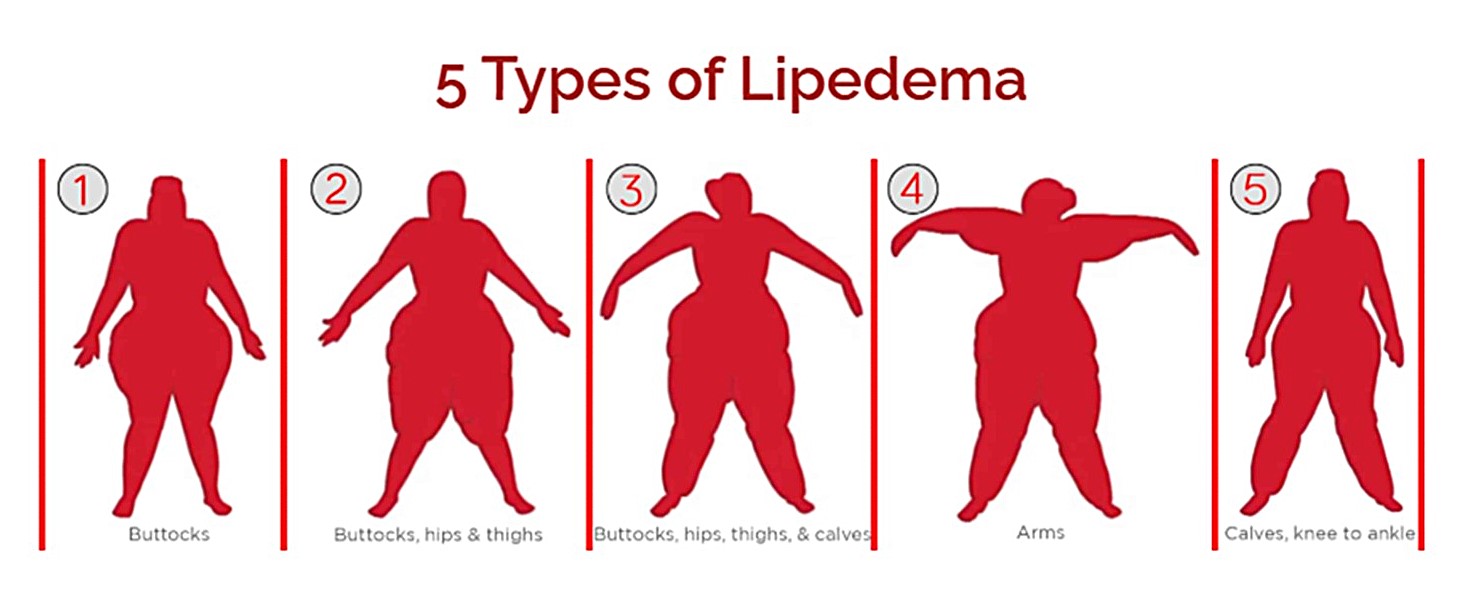
Courtesy of The Lipedema Project
Does lipedema affect the hands or feet
While lipedema fat most often involves the butt, thighs and calves and can develop in the hips or upper arms (lipedema in arms), lipedema doesn’t develop in or affect the hands or feet.
Can I get lipedema in just one limb
Unlike most fat accumulation patterns, lipedema fat develops symmetrically, meaning that it affects both sides of the body equally, differentiating it from conditions like lymphedema, which often affects only one limb.
How is lipedema different from lymphedema (lipedema vs lymphedema)
Lipedema is completely different from lymphedema. Lipedema is a condition involving the abnormal distribution of fatty tissues within the body, while lymphedema is a disorder of the lymphatic system.
Can I have both lipedema and lymphedema
Being a disorder involving the distribution of fatty tissue and not primarily a lymphatic disorder , if lipedema progresses it can eventually impact lymphatic function that leads to the development of lymphedema.
What are the stages of lipedema development (lipedema stages)
- Stage 1 lipedema: In the earliest and mildest form of lipedema (lipedema stage 1) where the skin still looks normal, but small nodules (feel like pebbles) begin to develop within fatty deposits under your skin
- Stage 2 lipedema: As the fatty tissue builds up (lipedema fat), the texture of the skin surface changes
- Stage 3 lipedema: This is the advanced stage of lipedema, which is characterized by fatty tissue volumes that have significantly increased and increasingly become hardened and firm
- Stage 4 lipedema: This is the final advanced stage of lipedema development and is referred to as lipo-lymphedema, which means that you have both lipedema and lymphedema at the same time
Once it develops, lipedema generally will slowly worsen with time. The development of lipedema has be categorized within one of four progressively worse stages of lipedema. These four stages of lipedema are as follows:
What are the complications of having lipedema
- difficulty with walking
- venous (vein) disease
- flat feet
- joint issues
- knock knees (knees touch each other when your feet are apart)
- secondary lymphedema or lipo-lymphedema (blockage in the lymphatic pathway resulting in lymph fluid to build up)
- infection (cellulitis)
- feelings of embarrassment and anxiety
- depression
Living with lipedema can make normal daily activities difficult to perform and can impact your overall quality of life and lead to other complications such as:
How can I cure or how to get rid of lipedema
There isn’t a cure for lipedema, however treatment for lipedema can help you feel better and make it easier to live a normal, active lifestyle. Early recognition and diagnosis of lipedema symptoms, along with an appropriate treatment protocol can help you manage the symptoms and slow the progression of the condition.
What is the treatment for lipedema / lipedema treatment
There is no cure for lipedema, however there are a variety of lipedema treatment methods that can be prescribed for helping manage lipedema symptoms, reducing pain and inflammation, and slowing the condition's progression. The treatment for lipedema includes protocols which will typically be tailored to your individual lipedema symptoms and stage of lipedema.
How to treat lipedema: Are there simple treatments for lipedema that I can do myself
- Exercise: simple low-impact exercises such as swimming, biking and walking can help with weight management, promote circulation, improve mobility and reduce swelling. Exercising in a pool can also help reduce stress on your joints.
- Heart-healthy, low-carb, anti-inflammatory lipedema diet: while this won’t affect the underlying fatty tissue, a healthy lipedema diet may help slow the progression of lipedema.
- Skin care: keeping your skin clean and moisturized will help maintain overall skin health around the affected areas to help prevent infection such as cellulitis.
- Medications or supplements: your healthcare provider may prescribe certain medications to help with inflammation, swelling and pain.
Therea are several simple treatments for lipedema that you can do yourself, including the following:
Are there other noninvasive lipedema treatments that my doctor my prescribe
- Compression therapy: compression, such as wearing a compression stocking for lipedema in legs, compression sleeves for lipedema in arms, leggings or compression shorts can help with swelling (edema) and promote circulation.
- Manual Lymphatic Drainage (MLD): this is a specialized, gentle massage technique that stimulates lymph fluid and helps reduce edema (swelling) in lipedema legs.
- Complete Decongestive Therapy (CDT): this combines both the manual lymphatic drainage (MLD) massage followed by wearing a compression bandages or a garment (usually a compression wrap) to help maintain the volume reduction in lipedema legs obtained by the MLD.
- Pneumatic Compression Device: a compression pump is a mechanical means for providing pressure to your lipedema legs to help reduce swelling and promote fluid flow and lymphatic drainage.
Depending on the stage of the lipedema, other noninvasive treatment for your lipedema may be prescribed, including:
My lipedema isn’t improving, so are there other lipedema treatments that I can try
- Liposuction: this is used to remove fatty tissue, help reduce pain and improve mobility.
- Bariatric surgery: when lipedema exists with a BMI exceeding 35, your healthcare provider may recommend bariatric surgery to help manage and control your weight.
- Excision surgery: may be used for advanced stages of lipedema to remove large, fibrotic, or nodular tissue deposits.
- Skin Removal Surgery: After fat removal or loss, a skin removal procedure may be necessary for sagging skin.
In the more extreme lipedema stages invasive surgical treatment (lipedema surgery) may be necessary to help alleviate pain and swelling. Invasive treatments / types of lipedema surgery include the following:
Is lipedema treatment covered by insurance
- functional impairment or disability
- the need for pain relief
- other criteria which demonstrates a medically necessary need for treatment
The answer as to whether lipedema treatment is covered by insurance is not straightforward and simple. For your lipedema treatment to be covered by insurance, there is usually a minimum threshold which requires proof that the lipedema treatment is "medically necessary". The medical necessity threshold will likely need to be supported by a documented medical diagnosis and will generally involve certain criteria such as:
How can I lower the risk of getting lipedema
Since we do not know exactly what causes of lipedema or lipedema causes, it makes it difficult to avoid getting it. However, if you have some of the risk factors for developing lipedema (being female and/or having a family history of lipedema), the best prevention against getting lipedema that you can control is to maintain a healthy weight, through proper diet and exercise.
What is the best approach for living with lipedema
While some people with lipedema will have mild symptoms that don’t get worse with time, many have lipedema that progressively worsens with time. Regardless of the type and severity of lipedema, early diagnosis and treatment for lipedema is the best solution should it develop It will be very important to follow the lipedema treatment plan that your healthcare provider prescribes. Exercise, weight loss and compression will help lead to a better lipedema treatment outcome, while medications and surgical intervention can help you feel better. Counseling or support groups can help provide the mental and emotional support that you need to help navigate the psychological impact of living with lipedema.